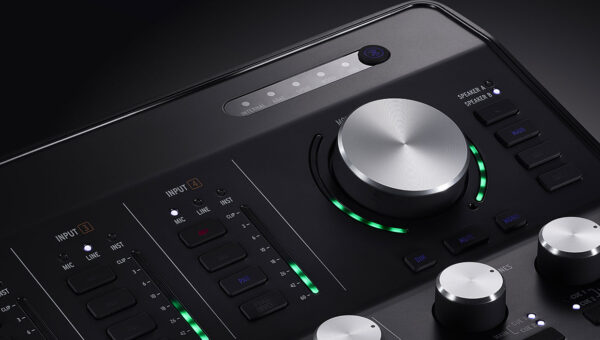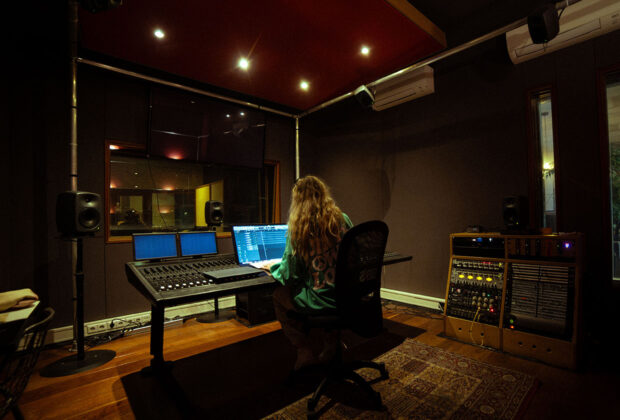
SAE Institute Amsterdam has built its reputation on practical, industry-standard training, and much of that training runs through Audient gear. The company’s interfaces, preamps, and consoles show up in nearly every room on campus, from the smallest vocal booth to the main studio floor. So when the school set out to build a dedicated Dolby Atmos teaching space, there was little debate about what would sit at the center of it: Audient’s ORIA, a monitor controller built specifically for immersive audio work.
Giacomo Piscitelli, Head of the Audio Department at SAE Institute Amsterdam, has spoken about why the department moved on immersive audio when it did, and why ORIA became the anchor for the new room. “Across our SAE region, including Germany, Switzerland and Austria, there was a clear decision that immersive audio had to become part of the student experience,” he says. “So we had to move quickly and make sure the setup was implemented properly.”
ORIA’s tuning and calibration tools mattered as much as its Dolby Atmos support. “They allowed us to work with the right external partners while still using ORIA as the central system to align the room to the Dolby curve and Dolby requirements,” Giacomo notes. With Atmos now a fixture in post-production and increasingly in music, he’s direct about the goal: “We want our students to graduate with experience on the systems and workflows they will actually encounter in the industry.”
One Language, Across Every Room
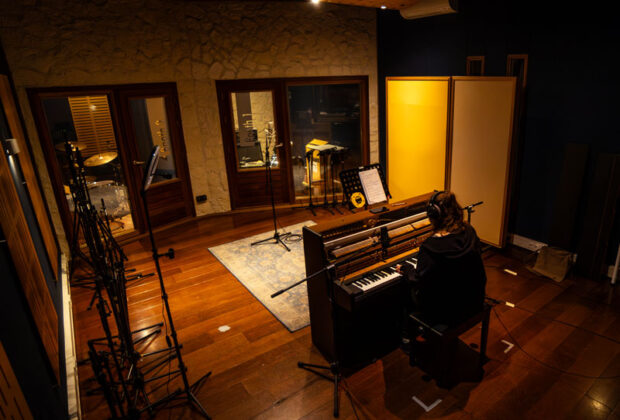 The rest of SAE Amsterdam’s studios build toward that same room. Students start on portable iD4 and iD44 interfaces, move to the rackmount iD48 connecting live rooms to production studios, work with ASP880 preamps in Studio 1, and eventually sit behind the ASP8024 console in Studio 3, often their first time on a console of that scale.
Giacomo describes it as one design language carried across every room rather than a new system to decode at each stage. “Students can start on a smaller interface and then move into larger studio environments without feeling like they are learning a completely different system every time,” he says. “The signal flow, the sound quality and the general design philosophy remain familiar.”
There’s a durability angle too, one he doesn’t dress up. “Students are learning, experimenting and making mistakes, so the gear has to be solid,” he says. “Audient has always been a reliable manufacturer for us, with quality that meets professional standards.” He calls it the test of learning: equipment that survives a semester of first-year students is a different bar than a controlled studio session.
Built for the Classroom
A professional Atmos rig doesn’t automatically make a good teaching rig, and multi-speaker arrays can intimidate students before they’ve mixed a single note. That’s the problem ORIA solved in Studio 1. “We now have a much more plug-and-play system,” Giacomo says. “Students can come in, connect their laptop, use the ORIA app and access the speaker system through their internal renderer.” Sessions that once required routing and patch bay work now start over a single USB cable, and the physical controls stay simple enough that “students do not feel intimidated by the system.”
That accessibility shows in how students respond the first time they hear a mix across real speakers instead of headphones. “The first time students hear their work in the room, there is always a strong reaction,” Giacomo says. “They are impressed by the scale of it, and it immediately opens up creative ideas.” Thesis and major projects have started building toward the space from the outset rather than translating into it afterward, and this September, SAE Amsterdam becomes the first SAE campus globally to run a Dolby-certified Immersive Mixing Certificate built around the room.
Beyond Music and Film
With the room established, the department’s next target is game audio, specifically the interactive, non-linear side of mixing for 3D environments. “We already have the Atmos room in place, and now the goal is to expand how students can use that environment beyond music and film,” Giacomo says. The plan connects middleware like Wwise to the ORIA-powered setup, letting students mix audio that has to respond to a player rather than play back the same way every time. “That is the next sonic boundary,” he says. “Film and music are already strong areas for us, but game audio offers another level of creative possibility.”
Learn More