Most guitar strings end the same way. A player breaks one in the middle of a set, pulls the whole set off, and drops the coil in a case pocket or a trash can without a second thought. Multiply that by every touring band, every weekend player, every studio session, and the number adds up fast: roughly 1.5 million pounds of used strings a year, much of it steel that curbside recycling programs aren’t built to handle.
Dan Tremonti, cofounder of the Chicago shop FRET12, noticed the same waste from the other side of the stage. “I was backstage at a show years ago, and I was talking with a guitar tech during a set,” he said. “He opened the drawer of his road case and there was a stack of used strings inside, each set neatly coiled, each labeled with a piece of gaffer tape marking a city and a date. He’d been saving them as mementos from the tour, and it completely reframed how I thought about used strings. I’d never seen someone treat them as artifacts, and I couldn’t stop thinking about it.”
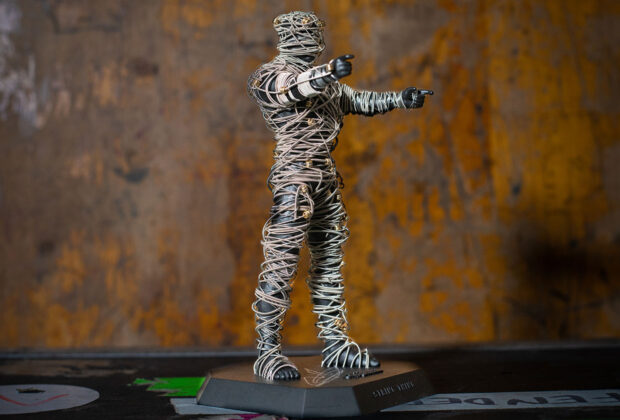
That drawer became the starting point for the String Thing, a small figure designed to be wrapped, strung, and rebuilt with a player’s own retired strings instead of thrown away with them.
The Anatomy of a Mummy
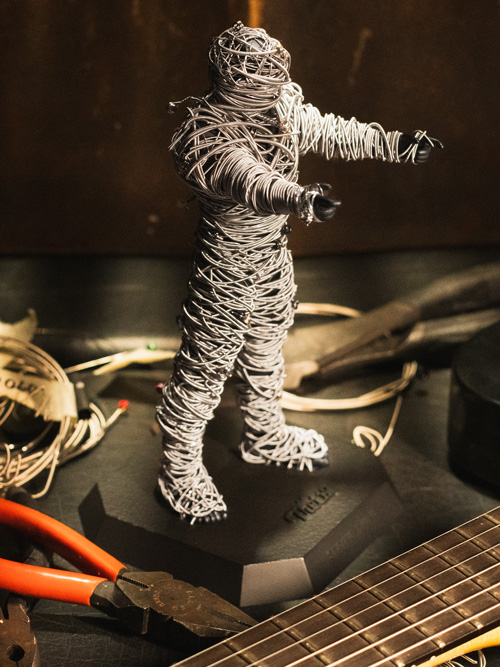 The String Thing ships bare: a figure standing 8.75 inches tall on a 4.75 inch base, molded in black plastic and set with 139 holes drilled in advance for guitar and bass strings up to 0.090 gauge. Heavier strings, and pretty much anything else a player wants to work in, can be woven through rather than threaded. FRET12 estimates eight to ten sets of strings will fill it out, though the figure looks intentional at any stage of the process, from the first string to the last open hole.
The shape itself came out of that same backstage encounter. “The mummy came directly from that first experiment,” Tremonti said. “After the tech gave me a batch of saved strings, I ended up wrapping them around a small figure in my studio, half as a joke, just to see what a guitar string mummy would look like. What I ended up with was this little character in a mummy pose, and something about the image locked in. That original stance is what made the product possible, because it had to look striking at every stage of use, not just when it was fully wrapped.”
Building One
There’s no fixed method. FRET12 suggests pliers and wire cutters for handling stiffer strings, starting with the drilled holes as anchor points, using ball ends where useful, and weaving under previous strings to build tension and hold shape. Beyond that, it’s left to the player. Some wrap methodically by string gauge or by the date a set was played; others treat the figure as a running collage, adding a string here and there as sets wear out over months.
Tremonti sees that openness as the point rather than a limitation. “We’ve already put the String Thing on tees, art prints, and a custom collaboration pedal with EarthQuaker Devices, and each one has given it a new dimension,” he said. “What I’d really love to see is people getting wild with their own, customizing them, painting them, treating the underlying figure as a canvas. The character gets more interesting the more people put their own fingerprints on it.”
The Point of All This
Guitar strings are one of the few consumables in a player’s setup that carry a specific memory attached to them, a string that broke during a difficult take, or one that got them through a long set. Most of that history gets discarded without ceremony. Tremonti has noticed that, too. “They break a string during a show and they can’t wait to toss the set in a bin,” he said. “I don’t think they have really been thought of as a testament to all of your hard work as a player.”
For FRET12, the String Thing is less a novelty item than a compact version of what the shop is trying to do more broadly. “The String Thing is basically a distillation of what FRET12 is trying to do,” Tremonti said. “Everything we make, from the clothing, the artwork, and the sessions, to the shop itself, is built to give people a deeper way into music culture than what they see from the outside. The String Thing does that at the individual level: it takes something visible that a guitarist has already made, the physical evidence of hours of playing, and turns it into a keepsake tied to specific moments and specific songs.”
One More String
The String Thing won’t change how anyone plays. What it changes is the small decision at the end of a string’s life: bin or keepsake. For players who’ve never thought of a spent set as anything more than something to replace, it offers a second use worth considering. Players interested in donating rather than building can also send used strings to recycling programs like D’Addario’s Playback initiative, which FRET12 points to directly on its product page.
The String Thing is available now through FRET12 for $44.